If you wake up with a sore jaw, catch yourself clenching at your desk, or hear a click when you chew, you may be carrying more tension around your jaw than you realize. It can also show up as a headache at your temples or tightness that travels into your neck and shoulders.
Edmonton’s seasons and routines can add to that load. You might tense your jaw against the cold on a walk along Whyte Avenue, hunch through a downtown commute, or stay braced over a screen during a long workday. During a busy stretch at the University of Alberta, stress can make those habits even easier to miss.
A focused massage may help ease muscle tension and improve comfort. It does not diagnose or cure a temporomandibular disorder. Here’s what to know before you book.
What are the TMJ and TMD?
Your temporomandibular joints, or TMJs, are the hinges on either side of your face, just in front of your ears. They connect your lower jaw to your skull and help you speak, chew and yawn.
“TMJ” is often used casually to describe jaw problems, but temporomandibular disorders (TMD) is the term for a group of conditions affecting the joint and the surrounding muscles. As Mayo Clinic explains, symptoms can include jaw pain or tenderness, difficulty chewing, headaches and reduced jaw movement.
Common signs may include:
- Clicking or popping when you chew or yawn
- Soreness or fatigue in the jaw, especially in the morning
- Pain when chewing or opening your mouth
- Tension around your temples, ears, neck or shoulders
- A feeling that your jaw does not open as freely as usual
A sound by itself does not necessarily mean you have a disorder or need treatment. But ongoing pain, restricted movement or symptoms that affect daily life are worth discussing with a dentist or physician.
Why jaw tension can build up
Your jaw muscles work throughout the day. Clenching: sometimes linked with stress or nighttime teeth grinding, also called bruxism, can leave them feeling overworked. You might not notice it happening, especially when concentrating on a screen or dealing with a deadline.
Cold-weather habits can play a part, too. If you hunch your shoulders and tighten your face while walking in the wind or shovelling snow, your jaw may join in. Neck and shoulder tension can accompany jaw tightness, so it can help to consider the whole area rather than focusing only on your face.
How TMJ massage may help
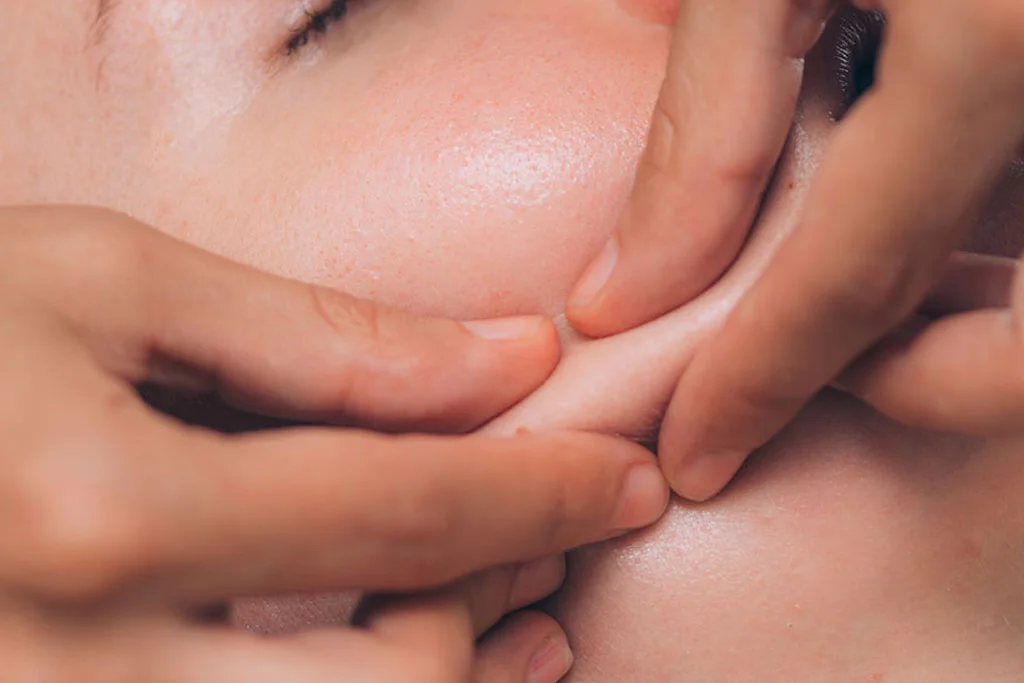
TMJ massage focuses on the muscles around the jaw and the surrounding areas that may feel tense or tender. A registered massage therapist trained in TMJ work may use gentle external techniques on the masseter (the broad cheek muscle), temporalis (at the temples) and, where appropriate, the deeper pterygoid muscles.
Some therapists may offer intra-oral work, which means working on certain muscles from inside the mouth. This should only be considered with your informed consent and by a practitioner trained to provide it. You can ask questions, decline any technique or request a change in pressure at any point.
Your therapist may also work on your neck and shoulders if those areas feel tight. The aim is to support muscle relaxation and comfort, not to reposition your jaw or promise a cure.
Evidence for hands-on care varies. Research on manual therapy for TMD includes different approaches, such as mobilization, exercise and soft-tissue techniques; it does not establish massage alone as a solution for everyone. That’s why massage is best viewed as a possible complement to dental or medical guidance.
What to expect at a session
A comfortable session starts with a conversation, not hands-on work. Your RMT can ask about your symptoms, what aggravates them, and what you hope to get from treatment. They should explain the options and check your comfort before starting.
Treatment may include gentle work around the jaw, temples, neck and shoulders. If intra-oral techniques are offered, your therapist should explain what they involve and ask permission first. You can speak up if anything feels uncomfortable.

At Massage Quest, registered massage therapists provide personalized care in a cozy, calming setting. If you’re exploring massage therapy Edmonton options, you can read about TMJ massage or visit the TMJ massage service page for details. You can also browse Massage Quest services to compare other treatments.
Small habits to try between appointments
If you notice yourself clenching, a gentle reminder can help: let your jaw rest, with your teeth slightly apart rather than pressed together. You can also try:
- Taking screen breaks to relax your shoulders and check your jaw position.
- Avoiding gum chewing during a flare-up if it increases soreness.
- Applying a comfortably warm compress to the jaw area.
- Using a scarf or other warm layers in cold weather, and noticing if you’re tightening your face.
- Trying a simple stress reset, such as slow breathing or a short walk.
Keep the movements easy; don’t force your jaw open or press hard on a sore spot. If grinding at night is a concern, ask a dentist whether an assessment or other support makes sense for you.
When to seek professional assessment
A massage therapist can work with muscle tension, but cannot diagnose the cause of jaw symptoms. Check in with a dentist or physician for persistent or worsening pain, changes in your bite, or difficulty opening or closing your mouth. Seek prompt care if your jaw locks or you cannot open or close it normally.
If you’re looking for a massage therapist in Edmonton to discuss jaw and related muscle tension, Massage Quest offers easy booking, same-day appointments when available and direct insurance billing. You’re welcome to ask questions before scheduling. Book a TMJ massage and start with a calm conversation about what you’re experiencing.